
Daily Reflection
Select a Date
Reflection for November 10, 2025
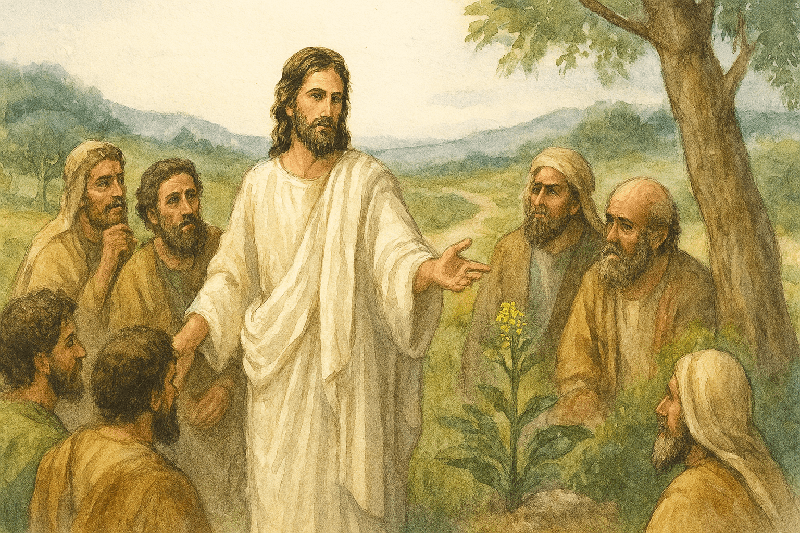
The Weight of a Millstone and the Power of a Mustard Seed
In this short, powerful passage from the Gospel of Luke, Jesus presents us with two seemingly contrasting images: the heavy, crushing weight of a millstone and the tiny, almost invisible mustard seed. At first glance, they appear unrelated, but held together in the light of faith, they reveal a profound truth about the gravity of our actions and the God-given power of our response.
The Gravity of Scandal: The Millstone
Jesus begins with a sobering warning: “Things that cause people to stumble are bound to come, but woe to that person through whom they come.” He speaks of scandal—not in the modern, often trivial sense—but in its most devastating, spiritual form. To cause scandal is to place a stumbling block in the path of a fellow believer, to be an occasion for another’s sin or loss of faith.
The imagery Jesus uses is shockingly severe: “It would be better for them to be thrown into the sea with a millstone tied around their neck than to cause one of these little ones to stumble.” A millstone was a massive, heavy stone used for grinding grain. To be drowned with one was a symbol of utter and irreversible destruction.
Why such a strong warning? Because as members of the Body of Christ, we are never isolated. Our actions, our words, and especially our public hypocrisy or silent complicity in sin have a ripple effect. When we who call ourselves Catholic live in a way that contradicts the Gospel—through cruelty, dishonesty, injustice, or sacrilege—we can lead others to doubt, to despair, or to believe that the faith is a hollow shell. Jesus reserves his strongest “woe” for this, reminding us of our immense responsibility toward one another, especially the “little ones”—the weak, the new in faith, the children, and the searching.
The Call to Radical Mercy: “If Your Brother Sins…”
Immediately after this warning about causing sin, Jesus turns to our response when we are the ones sinned against. He calls us to a radical and demanding practice of mercy and fraternal correction.
“If your brother or sister sins against you, rebuke them; and if they repent, forgive them. Even if they sin against you seven times in a day and seven times come back to you saying ‘I repent,’ you must forgive them.”
This is the other side of the coin. We must be fiercely vigilant not to lead others into sin, and we must be endlessly generous in forgiving those who sin against us. The call to “rebuke” is not a license for self-righteous anger but a charge to lovingly correct, to seek the good of the other’s soul. And the call to forgive is limitless, mirroring the infinite mercy of God the Father. It is a forgiveness that is not based on feeling, but on a deliberate act of the will, in imitation of Christ on the Cross.
The Apostles’ Plea: “Increase Our Faith!”
Faced with this twin demand—to avoid all scandal and to offer boundless forgiveness—the Apostles cry out with a honesty that resonates in our own hearts: “Increase our faith!”
They understand perfectly. They know their own weakness. They know that what Jesus is asking is humanly impossible. It requires a strength that does not come from within themselves, but from God alone. This is not a cry of despair, but a prayer—one of the most fundamental prayers we can ever utter.
The Promise of the Mustard Seed
The Lord’s response is both a consolation and a challenge. “If you have faith as small as a mustard seed, you can say to this mulberry tree, ‘Be uprooted and planted in the sea,’ and it will obey you.”
He does not scold them for their small faith. Instead, He reveals its explosive potential. The mustard seed is proverbially tiny, yet it grows into a great tree. Jesus is telling us that it is not about the quantity of our faith, but its quality and its object. A tiny, genuine, and active faith placed in the omnipotent God is enough to accomplish the impossible.
What are the “mulberry trees” in our lives that need uprooting? Perhaps it is a deep-seated resentment that feels as immovable as a tree. Perhaps it is a habit of sin that causes scandal. Perhaps it is the sheer difficulty of forgiving someone for the seventh time. Jesus says that the tiny seed of faith, nourished by prayer and the sacraments, has the divine power to move these mountains—or plant them in the sea.
Conclusion
In this passage, the Lord gives us a clear and challenging path of discipleship. He calls us to a profound awareness of our responsibility to others and to a superhuman standard of forgiveness. The weight of this call can feel like a millstone around our own necks.
But then He points us to the solution. We are not called to do this with our own strength. We are called to turn to Him and pray, “Lord, increase our faith!” We are called to trust that even our weak, faltering, mustard-seed faith, when placed in His hands, is enough. It is enough to protect the little ones, enough to forgive the unforgivable, and enough to uproot the deepest sins and plant our souls firmly in the grace of God.
Lord Jesus, protect me from ever being a cause of scandal for another. Grant me the courage for fraternal correction and the superhuman grace to forgive as I have been forgiven. When I feel overwhelmed by your call, remind me of the power of the mustard seed. I believe; help my unbelief. Increase my faith. Amen.