Daily Reflection
Select a Date
Reflection for November 14, 2025
The Unseen Threshold
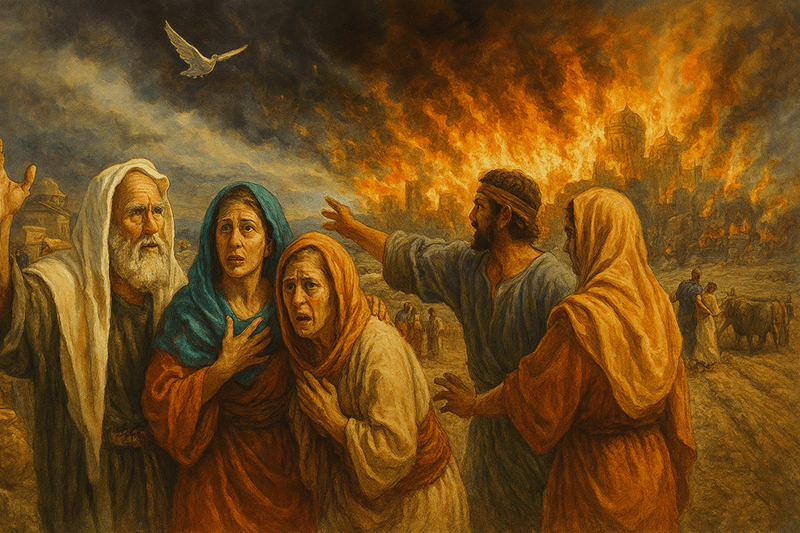
The Gospel passage from Luke 17:26-37 presents us with one of Jesus’ most urgent and challenging teachings. He speaks of the days of the Son of Man—the time of His final coming in glory—and uses two powerful analogies from the Old Testament: the days of Noah and the days of Lot. At first reading, the imagery of sudden destruction and the stark warning, "Where the body is, there also the vultures will gather," can feel jarring and severe. Yet, within this urgency lies a profound call to spiritual awareness and a radical reorientation of our lives.
The Sin of Normalcy
The key to understanding this passage lies not in the dramatic events of the flood or fire, but in the mundane, everyday activities that preceded them. Jesus highlights that in the days of Noah, people were "eating, drinking, marrying, and being given in marriage." In the days of Lot, they were "eating, drinking, buying, selling, planting, building." There is nothing inherently sinful about these activities. In fact, they are the very stuff of ordinary human life, gifts from God to be received with gratitude.
The sin was not in the actions themselves, but in the disposition of the heart. It was a total absorption in the temporal world to the complete exclusion of God. It was a life lived on a purely horizontal plane, with no vertical dimension pointing toward the transcendent. They were so engrossed in the "business as usual" of the world that they became blind to its spiritual emptiness and the impending judgment. This is a sobering warning for us today. Our culture often prizes busyness, productivity, and the pursuit of comfort above all else. Jesus asks us: Are we so absorbed in the daily grind that we have forgotten we are eternal beings on a pilgrimage to our true home?
A Heart Detached and Ready
The Lord’s call is not to abandon our posts, flee society, and stop eating or working. Rather, it is a call to live in the world without being of the world (John 17:14-16). It is the spiritual discipline of detachment. The people of Noah’s and Lot’s time were attached to their world; it was their ultimate concern. The Christian is called to hold the things of this world lightly, with open hands, always ready to let go for the sake of the Kingdom.
This is the meaning behind the startling examples Jesus gives: the person on the housetop who must not go down for his goods, and the one in the field who must not turn back. He is not condemning family or property in themselves, but He is ruthlessly prioritizing the one thing necessary: salvation. He is warning against the inordinate attachment that would cause us to hesitate, to look back with longing (like Lot’s wife), and in doing so, to be lost. Our attachment to Christ must be so absolute that everything else, even the deepest and most legitimate human loves, is relativized.
The Two Pillars of Christian Hope
This passage, while stark, is fundamentally about hope. It is hope rooted in two core truths of our faith.
First, it is hope in the certainty of God’s justice. The world, with all its beauty and tragedy, is not hurtling toward meaningless chaos. It has a destination, a final reckoning where evil will be definitively defeated and God’s righteousness will be fully established. This is our comfort in the face of injustice and suffering.
Second, it is hope in the personal return of Jesus Christ. The "Day of the Lord" is not an abstract concept; it is the return of a Person who loves us. The early Christians prayed, "Maranatha! Come, Lord Jesus!" (Revelation 22:20). This should be the cry of our hearts as well. The final judgment is the moment when the Bridegroom comes for His Bride, the Church, to bring her into the eternal wedding feast.
Examination and Invitation
As we reflect on this Gospel, we are invited to examine our own lives:
Where am I living as if this world is all there is?
To what comforts, routines, or relationships am I so attached that they would make me hesitate to follow Christ completely?
Do I live with a joyful expectation of Christ’s return, or does the thought fill me with fear?
The Lord does not give us this warning to frighten us, but to awaken us. He calls us to live not in a state of anxious scrupulosity, but in a state of vigilant love. Every Mass is a preparation for this reality. At the Consecration, the veil between heaven and earth is lifted, and we stand at the threshold of eternity. We receive the Lord Himself in the Eucharist, the viaticum—the food for the journey—that strengthens us to live as faithful and prudent servants, with our lamps lit, awaiting our Master’s return.
May the Holy Spirit grant us the grace of spiritual sight, to see the unseen reality behind our daily routine, and the courage to live each day with our hearts set on the one treasure that can never be taken away: our Lord and Savior, Jesus Christ.
Come, Lord Jesus!