Daily Reflection
Select a Date
Reflection for November 17, 2025
"Lord, Please, I Want to See"
The scene painted for us in the Gospel of Luke is one of poignant contrast. Jesus is approaching Jericho, surrounded by a crowd—a mixture of disciples, curious onlookers, and seekers. There is energy, noise, and movement. And on the periphery, sitting in the dust and darkness, is a blind beggar named Bartimaeus.
This man represents a state of profound helplessness. His blindness not only physically robbed him of sight but socially and economically relegated him to the margins. He was defined by his need, forced to rely on the charity of others just to survive. Yet, in this place of darkness, a light kindles. He hears the commotion and asks what is happening. The answer he receives changes everything: "Jesus of Nazareth is passing by."
The Courage to Cry Out
Upon hearing this, Bartimaeus does not hesitate. He begins to shout, "Jesus, Son of David, have pity on me!" Notice his audacity. The crowd, representing the world's voice of discouragement, tells him to be silent. They see him as a nuisance, an interruption to their important journey with the Master. But Bartimaeus refuses to be silenced. He cries out all the more.
How often do we, in our own spiritual lives, feel this same tension? We have a need, a pain, a "blindness"—a pattern of sin we cannot break, a grief that clouds our heart, a confusion about God's will. And the "crowd"—the distractions of the world, our own insecurities, the voice of the evil one—tells us to be quiet. "Don't bother God with that." "You're not holy enough." "Handle it yourself." Bartimaeus teaches us the first step of faith: defiant, persistent prayer. He teaches us to cry out to Christ even when everything and everyone tells us to give up.
The Question That Changes Everything
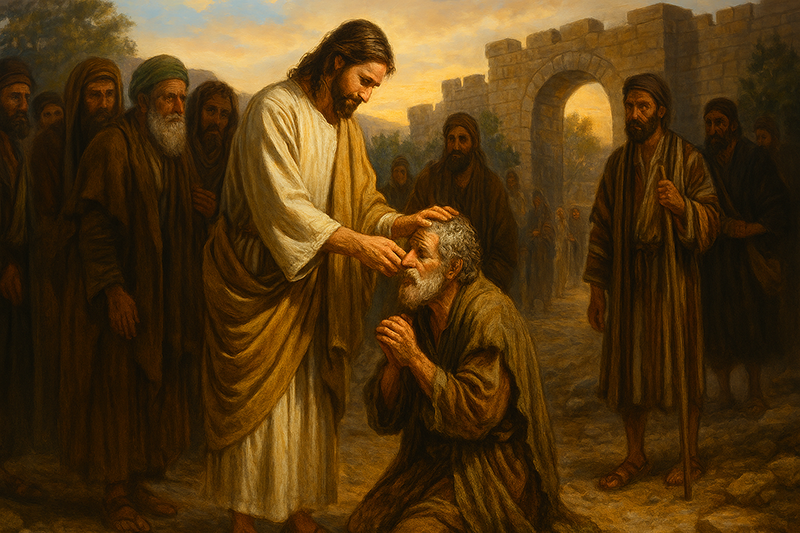
Jesus stops. The Creator of the universe halts His journey because of the cry of one poor, blind beggar. He orders the man to be brought forward. The same crowd that was shushing him now says, "Take courage; get up, Jesus is calling you."
And then comes the question, perhaps the most important question Jesus ever asks, one He asks each of us every day: "What do you want me to do for you?"
It seems obvious, doesn't it? The man is blind. But Jesus wants him to articulate his need. He wants him to name his desire. This is an invitation to faith, to a personal encounter. Bartimaeus could have asked for money, for food, for a easier life. Instead, he goes straight to the root of his suffering: "Lord, please, I want to see."
This is a prayer of stunning clarity and profound depth. It is the prayer of the sinner seeking mercy, the seeker longing for truth, the lost soul yearning for the light of Christ. "I want to see." He is asking for more than physical sight; he is asking for the light of faith to penetrate the darkness of his soul.
Go in Peace; Your Faith Has Saved You
Jesus’ response is immediate: "Have sight; your faith has saved you." The healing is instantaneous. Bartimaeus’s persistent, articulate faith was the channel through which God's grace poured into his life.
But the story doesn't end with his healing. The final line is crucial: "Immediately he received his sight and followed him, giving glory to God."
He didn't just get what he wanted and go back to his old life. He became a disciple. He followed Jesus on the way—the way that leads to Jerusalem, to the Cross, and to the Resurrection. His healing led to discipleship, and his discipleship led to evangelization, for "all the people who saw it gave praise to God."
For Our Lives Today
This Gospel invites us to place ourselves in the story.
What is my blindness? Where am I in the dark? Is it a sin I refuse to confess? A relationship that needs healing? A vocation I am ignoring? A truth about myself or God that I am afraid to face?
Do I cry out to Jesus with persistence? Or do I let the "crowd" silence me? Let us bring our needs to the Lord in the Sacrament of Reconciliation and in daily prayer, with the stubborn faith of Bartimaeus.
How do I answer Jesus’ question? "What do you want me to do for you?" Be specific. Be honest. Ask for the grace to see—to see His presence in the Eucharist, to see His image in our neighbor, to see His will in our daily circumstances.
The same Jesus who stopped for Bartimaeus is present with us now, most profoundly in the Holy Eucharist. He is passing by, right here, right now. Let us throw off our cloak of sin and shame, rise, and run to Him. Let us cry out from the depths of our hearts, "Lord, please, I want to see." And having received His healing grace, let us, like Bartimaeus, follow Him on the way, giving glory to God by our lives.
Amen.