
Daily Reflection
Select a Date
Reflection for November 20, 2025
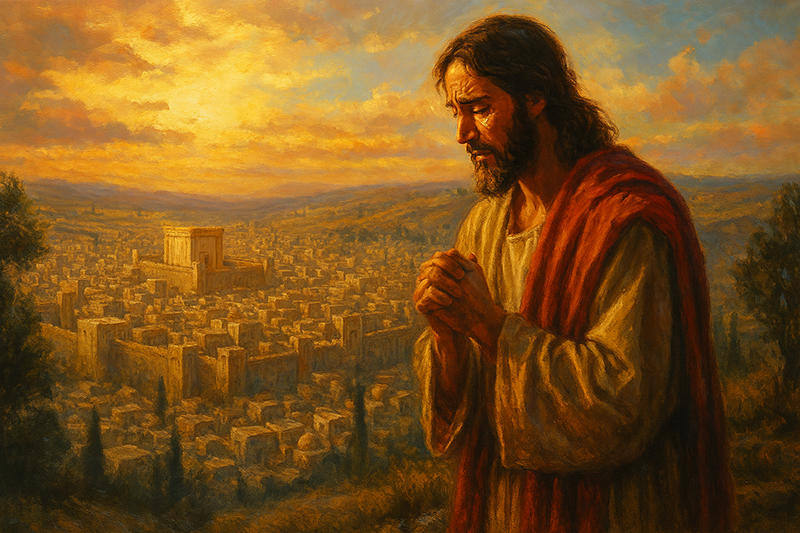
The Tears of Christ
The Human Heart of God
In the grand narrative of the Gospels, we see Jesus in many divine and powerful roles: the healer, the teacher, the master of the wind and waves. But in this poignant moment on the road to Jerusalem, we are granted a breathtakingly intimate glimpse into His sacred humanity and, through it, into the very heart of God the Father. Jesus does not simply look upon the city with disappointment or anger; He weeps. These are not quiet tears, but the deep, gut-wrenching sobbing of one who mourns a profound and personal loss.
He weeps not for Himself, though He knows the cross that awaits Him there. He weeps for Jerusalem—for the people He loves, for the lost sheep of Israel, for the tragic blindness that prevents them from seeing the peace He offers. This is the sorrow of a Creator for His creation, of a Bridegroom for His bride, who "came to what was his own, but his own people did not accept him" (John 1:11).
The Tragedy of Unrecognized Visitation
The core of Jesus' lament is this: "you did not recognize the time of your visitation." God Himself was walking in their midst, speaking their language, healing their sick, and offering a kingdom of love and mercy. Yet, they were looking for something else—a political liberator, a military messiah, a validation of their own religious expectations. Their hearts were so full of preconceived notions and worldly ambitions that there was no room to receive the God who came in humility and peace.
This is a piercing question for us today: Do we recognize the time of our visitation?
The Lord visits us in countless ways:
- In the Sacraments, most profoundly in the Eucharist, where He gives Himself to us as true food and drink.
- In the Scriptures, where He speaks to our hearts.
- In the cry of the poor and the marginalized, where He identifies Himself so intimately (Matthew 25:40).
- In the quiet moments of prayer, in the beauty of creation, and in the love of our families and communities.
When we are too busy, too self-assured, or too attached to our own plans to notice Him, we risk repeating the tragedy of Jerusalem. We choose the fleeting peace of the world over the lasting peace that only Christ can give.
The Fortress of a Closed Heart
Jesus prophesies a grim future for the city: siege, destruction, and desolation. The historical fulfillment of this prophecy in 70 A.D. is a stark metaphor for the spiritual reality of a soul that refuses God. When we bar the gates of our heart against Christ, we do not find safety. Instead, we find ourselves besieged by our enemies—fear, anxiety, sin, and despair. The "stones" of our self-built fortresses—our pride, our self-reliance, our addictions—are torn down, leaving us exposed and ruined.
True peace, the "shalom" that Jesus offers, is not the absence of conflict but the wholeness that comes from living in right relationship with God. It is the peace that guards our hearts and minds when we surrender to His will (Philippians 4:7).
A Call to Openness and Repentance
As we meditate on this scene, we are called to a spirit of humble introspection. Let us ask for the grace to see where we have been blind, where we have failed to recognize the Lord's visitation in our daily lives.
Lord, soften my heart. Do not let it become a fortress, but a welcoming home for you.
Open my eyes. Help me to see you in your Word, in the Sacraments, and in the face of my neighbor, especially the one who is difficult to love.
Grant me your peace. The peace that the world cannot give, the peace that flows from surrendering to your merciful love.
The tears of Jesus are a testament to the depth of His love for us. They are not tears of passive regret, but an active, pleading love that cries out even now: "If today you hear his voice, harden not your hearts" (Psalm 95:7-8). May we listen, and opening our gates, welcome the King of Peace.