Daily Reflection
Select a Date
Reflection for November 25, 2025
When Stones Fall
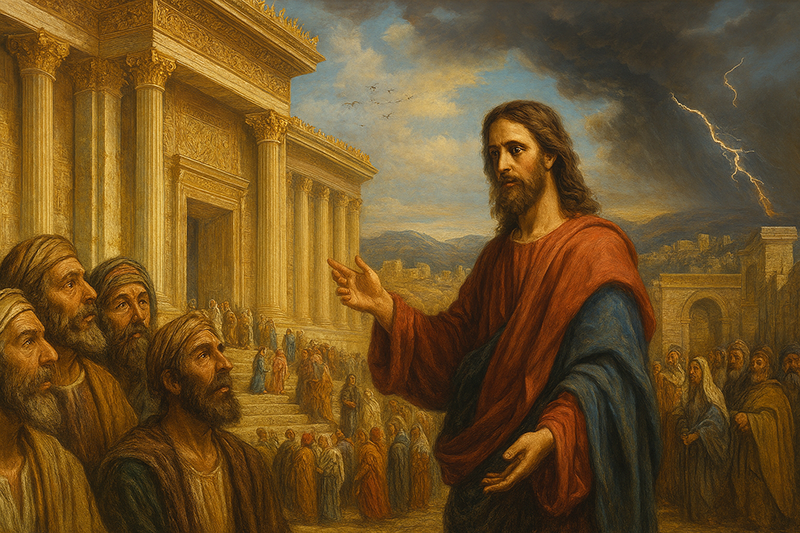
The human heart seeks permanence. We build, we plan, and we invest in things we believe will last—our careers, our reputations, our homes, and even our institutions of faith. In today’s Gospel from Luke, we find the disciples doing just that. As they leave the Temple, they marvel at its grandeur: its "costly stones and votive offerings." This was not just any building; it was the dwelling place of God on earth, the heart of Jewish worship, a symbol of divine promise and national identity. It was, in every sense, something meant to last.
Yet, into this moment of admiration, Jesus speaks a shocking prophecy: “All that you see here—the days will come when there will not be left a stone upon another stone that will not be thrown down.”
His words must have felt like a spiritual earthquake. He was not merely predicting an architectural demise; He was dismantling their entire framework of security and identity. The Temple, for all its holiness, was a temporary structure. Jesus points to a new and enduring reality: He Himself is the new Temple (John 2:19-21). The ultimate dwelling place of God is not in buildings made by hands, but in the person of Jesus Christ and, through Him, in the hearts of the faithful.
This revelation is as unsettling for us today as it was for the disciples. We, too, have our "temples"—the structures, routines, and securities we rely on. They can be physical, like our churches and homes, or they can be intangible, like our health, financial stability, or social order. Jesus’ warning is a perennial call to detachment from placing our ultimate trust in anything that can be destroyed. He asks us: Where is your foundation? In the stones of this world, or in the Rock of my Eternal Kingdom?
Naturally, the disciples’ next question is, “Teacher, when will this happen? And what sign will there be when all these things are about to happen?” They seek a timeline, a sign, a way to manage the coming chaos. But Jesus does not give them a date. Instead, He gives them a warning against a specific spiritual danger: deception.
“See that you not be deceived,” He begins, “for many will come in my name, saying, ‘I am he,’ and ‘The time has come.’ Do not follow them!”
This is the first and most critical lesson. In times of great uncertainty—when nations rise against nations, when earthquakes and famines and plagues shake the world—the temptation is to grasp for easy answers, for charismatic leaders who promise salvation through political, ideological, or even false religious means. Jesus tells us not to be terrified, for “these things must happen first, but it will not immediately be the end.”
The Catholic reading of this passage is not one of fear, but of sober hope and vigilance. The falling of worldly stones is not the end of the story; it is a necessary purification, a divine shaking of all that is not God, so that “what cannot be shaken may remain” (Hebrews 12:27).
So what are we to do?
Examine Our Foundations: We must ask ourselves daily: Am I building my life on the perishable stones of worldly success, comfort, and approval, or on the imperishable cornerstone, Jesus Christ? When the inevitable trials come, which foundation will hold?
Resist Deception: We live in an age of countless "messiahs" offering salvation through wealth, power, ideology, or spiritual fads. Our safeguard is an intimate relationship with Christ through prayer, the Sacraments (especially the Eucharist and Reconciliation), and a humble adherence to the teachings of His Church.
Live in Hope, Not in Fear: Jesus says, “Do not be terrified.” This is a command rooted in love. The turmoil of the world is the labor pain of a new creation, not the death rattle of the old. Our task is not to calculate the end times, but to be faithful in our present time—to love our neighbor, to perform the duties of our state in life with charity, and to trust in the ultimate providence of our Heavenly Father.
The falling stones of our lives—the personal losses, the societal upheavals—are painful. But through them, Christ is clearing the way for us to see more clearly that He alone is our sanctuary, our fortress, and our eternal peace. Let us not cling to the crumbling edifices of this world, but with hopeful hearts, let us run to the one Temple that will never be destroyed.
Come, Lord Jesus, be the cornerstone of our lives. When the world shakes and our securities crumble, grant us the grace to trust not in passing things, but in your eternal and unchanging love. Mary, Mother of Hope, pray for us that we may not be deceived or terrified, but remain steadfast in faith until the day of your Son’s return. Amen.