
Daily Reflection
Select a Date
Reflection for December 3, 2025
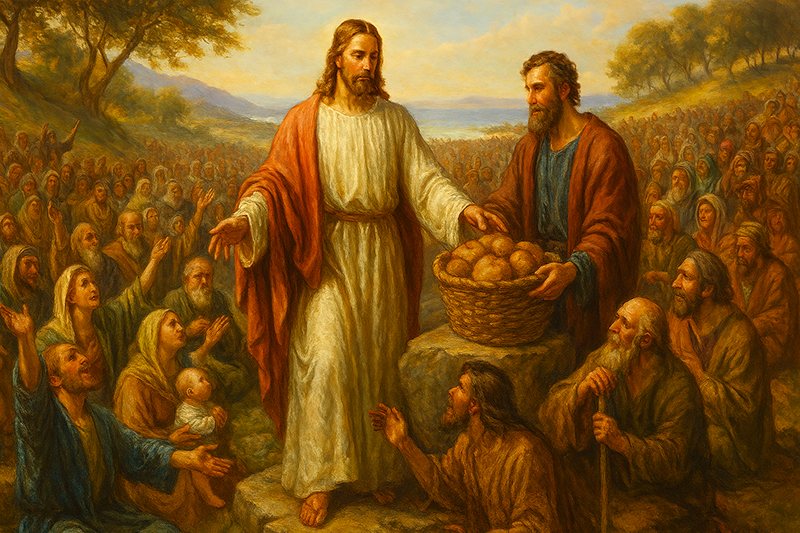
The Compassionate Christ and the Eucharist
In Matthew 15:29-37, we encounter Jesus at a pivotal moment of His public ministry. Having withdrawn to the shores of the Sea of Galilee, He is followed by great crowds—the lame, the blind, the crippled, and many others—all seeking healing and hope. With divine tenderness, Jesus heals them all, restoring not only their bodies but their dignity. Then, moved with compassion for the hungry multitude, He performs the miracle of the multiplication of the loaves and fishes, feeding over four thousand people with seven loaves and a few small fish, with baskets left over.
This passage reveals two profound truths about the heart of Christ and the mission of the Church: divine compassion and supernatural provision.
1. The Healing Touch of Jesus
The scene opens with Jesus surrounded by suffering humanity. In His presence, no ailment is ignored, no cry goes unheard. The Church, as the Body of Christ, is called to continue this healing mission. We are reminded that Christ’s compassion is not abstract—it is personal, tangible, and transformative. In the Sacraments, especially the Anointing of the Sick and Reconciliation, Jesus continues to touch our wounds and restore us to wholeness. As Catholics, we are invited to bring our own brokenness—physical, emotional, or spiritual—to Him, trusting that He still desires to heal us.
2. The Eucharistic Foreshadowing
The multiplication of the loaves is a powerful prefiguration of the Eucharist. Jesus takes the humble offerings—seven loaves and a few fish—gives thanks, breaks them, and distributes them through His disciples. In the same way, at every Mass, Jesus takes the simple gifts of bread and wine and transforms them into His own Body and Blood, feeding the multitudes of believers throughout time and space. The miracle points to a spiritual reality: Christ satisfies our deepest hunger, a hunger that material food cannot fulfill. In the Eucharist, we receive the "bread of life" (John 6:35), the true sustenance for our journey toward eternity.
3. The Call to Compassionate Service
Before performing the miracle, Jesus says to His disciples, "My heart is moved with pity for the crowd" (Matthew 15:32). His compassion moves Him to act. As followers of Christ, we too are called to be moved by the needs of others—both spiritual and material. The Church’s social teaching emphasizes our duty to feed the hungry, comfort the afflicted, and work for justice. The disciples’ role in distributing the food reminds us that God often uses our hands to answer the prayers of His people. In serving others, we become instruments of God’s providence.
4. Abundance in God’s Kingdom
The miracle ends with an abundance—seven baskets of leftovers, symbolizing the superabundance of God’s grace. In a world of scarcity and anxiety, Christ reveals that God’s generosity exceeds our expectations. This abundance is not merely material; it is the overflowing grace offered to us in prayer, in the Sacraments, and in Christian community. We are called to trust in divine providence, especially in times of personal or collective want, remembering that God can multiply our small offerings into blessings for many.
Personal Examination and Prayer
Let us reflect:
- In what areas of my life do I need Christ’s healing touch?
- Do I approach the Eucharist with faith, recognizing it as the true food that sustains my soul?
- How is Christ calling me to show compassionate service to those in need around me?
Prayer:
Lord Jesus, You are the compassionate Healer and the Bread of Life.
Heal my wounds, strengthen my faith, and make my heart responsive to the needs of others.
Help me to trust in Your abundant providence and to share Your love generously.
May I always recognize Your presence in the Eucharist and in the faces of those You place in my path.
Amen.
"Give us this day our daily bread." (Matthew 6:11)