
Daily Reflection
Select a Date
Reflection for March 10, 2026
When Forgiveness Feels Impossible
In Matthew's Gospel, Peter thinks he's being generous. He approaches Jesus with what he believes is a magnanimous proposal: "Lord, if my brother sins against me, how often must I forgive? As many as seven times?" (Matthew 18:21). Seven was the number of perfection, a complete and holy amount of forgiveness. Peter was ready to be praised for his spiritual maturity.
Jesus' reply must have stunned him. "I say to you, not seven times but seventy-seven times" (Matthew 18:22). In other words, stop counting. True forgiveness isn't a ledger where we track debts until we hit a limit. It’s a state of the heart.
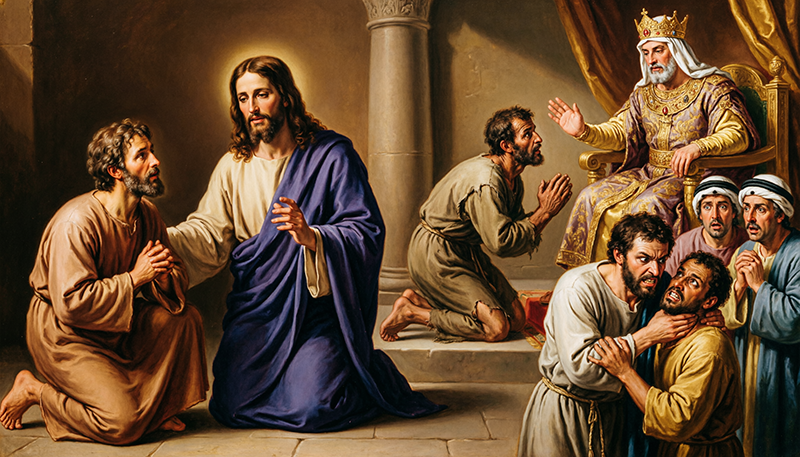
To drive the point home, Jesus tells the parable of the Unforgiving Servant. A man owes his king an astronomical debt—ten thousand talents—a sum so large it could never be repaid in a lifetime. It represents the infinite weight of our sin against God. The king, moved with compassion, completely forgives the debt. He doesn't postpone it or reduce it; he wipes it out.
This forgiven man then goes out and finds a fellow servant who owes him a very small sum—a hundred denarii, a few months' wages. When the second servant pleads for patience, using almost the exact same words the first servant had used with the king ("Be patient with me, and I will pay you back"), the unforgiving servant refuses. He has his fellow servant thrown into prison.
The contrast is jarring. Having received a pardon of cosmic proportions, he refuses to extend a pardon of petty significance.
This parable is a mirror for our souls. How often do we clutch onto small grievances, nursing wounds and demanding justice for slights, while completely losing sight of the monumental forgiveness we ourselves have received from God? Every sin we have ever committed—every moment of pride, lust, greed, and indifference—was a debt we could never pay. And yet, through the sacrifice of His Son on the Cross, God the Father has erased it entirely.
The parable ends with a terrifying warning: "So will my heavenly Father do to you, unless each of you forgives your brother from your heart" (Matthew 18:35). This isn't because God is petty, but because an unforgiving heart is a heart that has not truly understood or accepted the gift it has been given. It is a heart that remains closed, still living in the prison of its own debt.
In our own lives, the hurt can be deep—betrayal, abandonment, abuse. Forgiving "from the heart" doesn't mean pretending it didn't hurt, or that what the person did was acceptable. It means making a conscious choice to surrender our right to revenge and to wish them well, entrusting ultimate justice to God. It is an act of the will, enabled by grace.
The Catechism of the Catholic Church reminds us, "It is not in our power not to feel or to forget an offense; but the heart that offers itself to the Holy Spirit turns injury into compassion and purifies the memory in transforming the hurt into intercession" (CCC 2843).
When forgiveness feels impossible, we must first return to the foot of the Cross. We look at the debt that was forgiven there. And then, drawing from that bottomless well of mercy, we ask for the grace to let go of the small debts owed to us. For in the end, to forgive is to set a prisoner free and then discover that the prisoner was you.